

In an era marked by conflict and polarisation, art becomes a powerful form of resistance. At Northumbria University’s CHASE lecture, D6: Culture in Transit collaborators Dima Karout and Paul Nataraj examined how their practices foster coalescence - moments in which people, stories and care are held collectively despite the pressures that seek to pull them apart.
The lecture formed part of CHASE’s wider commitment to opening conversations on inequality, belonging and community wellbeing. Introduced by Professor Monique Lhussier, founding Director of CHASE, and chaired by D6’s Lead Producer Andrea Carter, it offered a rich exploration of how artists cultivate spaces for deep thinking, connection, repair and co-creation. This illustrated essay draws on the examples and insights they offered.
From Self to Collective to Ecosystem
Dima’s presentation focused on engaging with rupture in the context of war and conflict. And the artistic process that allowed her to ‘cut through the noise and bring the human back to the heart of the conversation’.
She shared that ‘rupture has been present not as a concept but as a lived experience of an ongoing separation.’ During the early years of the conflict in Syria, while living in Montreal, Canada, Dima said ‘there was nowhere to make sense of the chaos other than art. No other medium holds the capacity to allow us to understand the scale of loss and come to terms with who has the right to grief.’
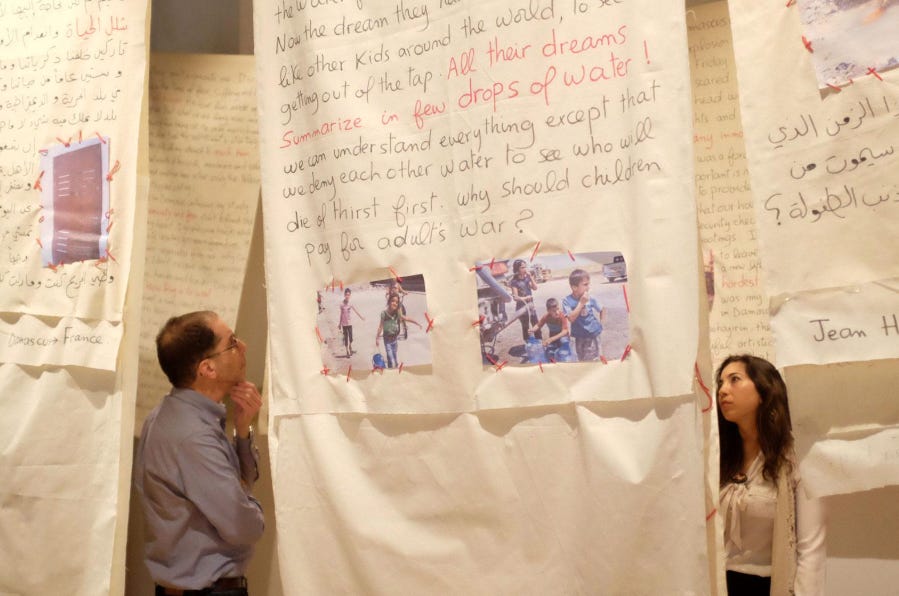
Socially engaged art offers us the capacity to engage with people, with their lives. We build from the individual to reach the collective. And Dima’s first example: Damascus Walls exhibition, presented at Montréal, Arts Interculturels in 2014, took us on a journey of her collaborative practice that began in Montreal as a response to the rupture caused by war. Seeking to understand the scale of loss from afar, she started to gather a multi-voices narrative and began with a question she sent to fellow Syrians across continents: ‘What was a difficult moment you experienced during the conflict?’ The answers arrived from different parts of the globe. ‘Some people were still in Syria. Others had fled to different countries. Artists, friends, family members. People of different backgrounds.’
What formed was not a survey but a chorus. A collective narrative that gave space to the human experience. Dima hand-wrote each story on two-metre lengths of fabric, in Arabic and English, stitched the photos that everyone sent to accompany their stories, and suspended them as an art installation she called Nasher - a word with the double meaning of hanging laundry and publishing. ‘Everyone who knew me at that time contributed something that showed up in the exhibition.’ The exhibition offered a space for connection, deep reflection and acknowledgment. Visitors stayed for hours immersed in these far away narratives, recognising themselves in fragments of other people’s lives.
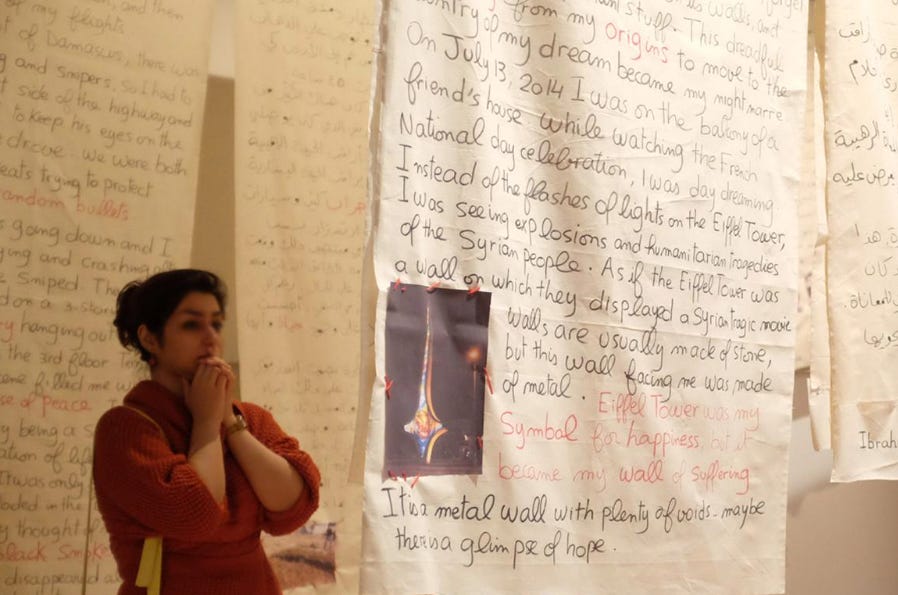
Dima speaks of an ecosystem rather than an artwork. ‘We moved from the self to the collective to the ecosystem,’ she says. ‘The institution’s team, the artistic community, the friends, neighbours, the visitors, and the Syrians who are not even here - everyone was working within this ecosystem to create meaning.’ She tells of friends stitching the photos to the fabrics in her living room, others revising languages and translations, some helping to attach contributors names on the suspended canvases, some carrying food through snowstorms to the opening, people crowdfunding to make it happen, collectors buying work online to support humanitarian initiatives, journalists writing about the work. ‘It made me think about the power of one,’ she explains. ‘Because every one of us showed up, the collective was empowered.’
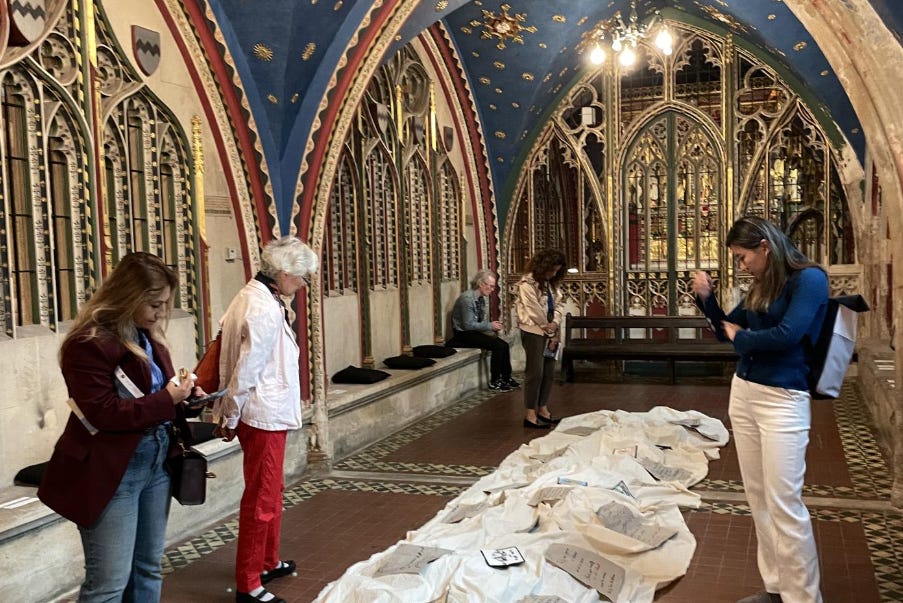
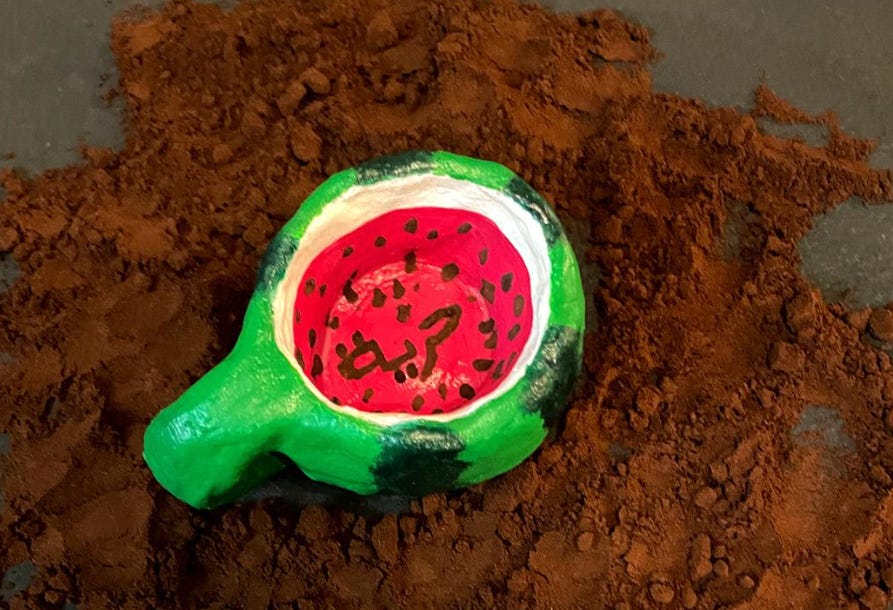
Her later project, The Places We Carry, at Grand Junction in London in 2024, follows the same artistic methodology and collective approach to community building. Dima was invited to work with local communities with heritage from the Middle East and North Africa, and design a final exhibition and public programme. She engaged with participants throughout art workshops and curated conversations. The project vision brought the institution’s team and local people together to engage in curated conversation, create art with different artists using different mediums, and to reflect on our evolving identity and connection to different geographies.
‘We went on to have an extended conversation for over six months, meeting every week. It was beautiful - we started to get to know each other, and people started bringing their different stories to the room. But there’s always been a parallel story happening. We’re talking about this, but what about Gaza? We’re talking about that, but what’s going on in Sudan? The conflict was always present and at the start, we didn’t know how to address it on a full scale because we didn’t want to bring trauma on top of the trauma.’
When they came closer to exhibiting the artworks, Dima invited everyone to engage with these difficult conversations as a collective, in solidarity, and to create a parallel space: ‘Inside the chapel, we designed a reflective space to express our solidarity with innocent civilians and stand against the erasure of indigenous people, landscapes and cultures - a space for Palestine, Sudan, Iraq, Syria, Libya, Lebanon, and Yemen… A space to document our shared humanity, and defend the right to words.’
Listening As Practice
Paul examines rupture through the medium of sound. ‘Sound is our most personal media,’ he says. ‘The will to listen reveals what is lost to silence.’ He traces rupture through diasporic histories - not only wars and postcolonial independence movements, but the quieter violences of misrepresentation, reduction and the erasure of nuance. ‘An act of silencing is an act of violence,’ he says, linking institutional narratives to lived fracture. ‘Censorship is power and control.’
In Blackburn in North West England, he encountered rupture framed through the lens of media. A project called Kick Down the Barriers, commissioned by Blackburn Museum and Art Gallery in 2020, asked local artists to respond to two BBC panorama documentaries about the racial divide in Blackburn. Paul described how the programme White Fright: Divided Britain, aired in 2018, portrayed Blackburn through a narrow frame, using ‘all the editorial devices… to present a version of Blackburn in which Asian and white communities were seen to be living completely segregated lives.’
‘Its divisive agenda was clear and unrepresentative of the lived experience of many people in the town, including my own as a mixed race person of Asian British heritage whose family home split the segregated divide.’
Blackburn’s multi‑racial social fabric was shaped by the cotton trade and garment manufacturing, a centuries‑old history rooted in Britain’s colonial past. Post‑war labour migration policies invited people from South Asia and Commonwealth countries to work in the mills: ‘these contexts are often cynically dismissed in order to disregard the deep historic and complex cultural entanglements which bind us,’ says Paul.
His response was to create long-form podcasts with residents in Whalley Range where they could speak for themselves. ‘It seemed fitting to produce a media product using completely opposing motivations… something anecdotal, vernacular, uncompromised.’ He spent months walking, talking, recording, sending edits back and forth. ‘The time frame allows the listener to absorb and reflect… Listening can function as a positive affirmation for those identified as other whose voices may have been previously silenced. This is a decolonial strategy, whereas an act of silencing is an act of violence.’
Paul brought these methods of collaboration into workshops with communities in Budapest and South Shields with We Sound Each Other, developed as part of D6’s international arts programme Contested Desires: Constructive Dialogue.
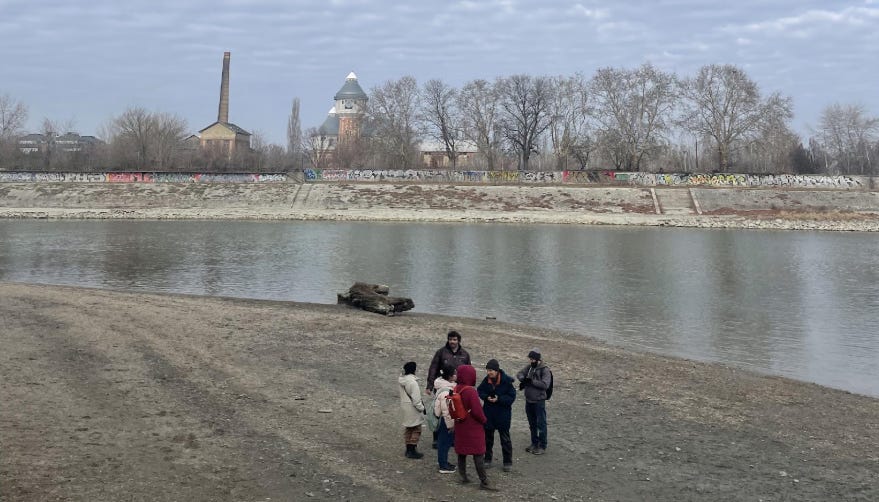
Starting with a residency with Pro Progressione in Budapest in Hungary, Paul became fascinated by the sound of right-wing political discourse. ‘Walking around the city, you can hear the echoes of revolution sounding out of the bullet holes still left in the walls and mixing with ghostly voices of the many statues whispering, telling tales of the country’s violent, complex and turbulent history. One might argue that the catastrophic political ruptures experienced by the people of Hungary have had a tangible effect on the protectionist policies of the present.’
He joined members of the intercultural community group Mira for a weekly walk and talk session, engaging participants in non-hierarchal processes of listening and sharing, with the option to speak in their own languages: ‘Their stories were amazingly insightful, beautiful, diverse, and surprising expressions of their migrant experiences.’
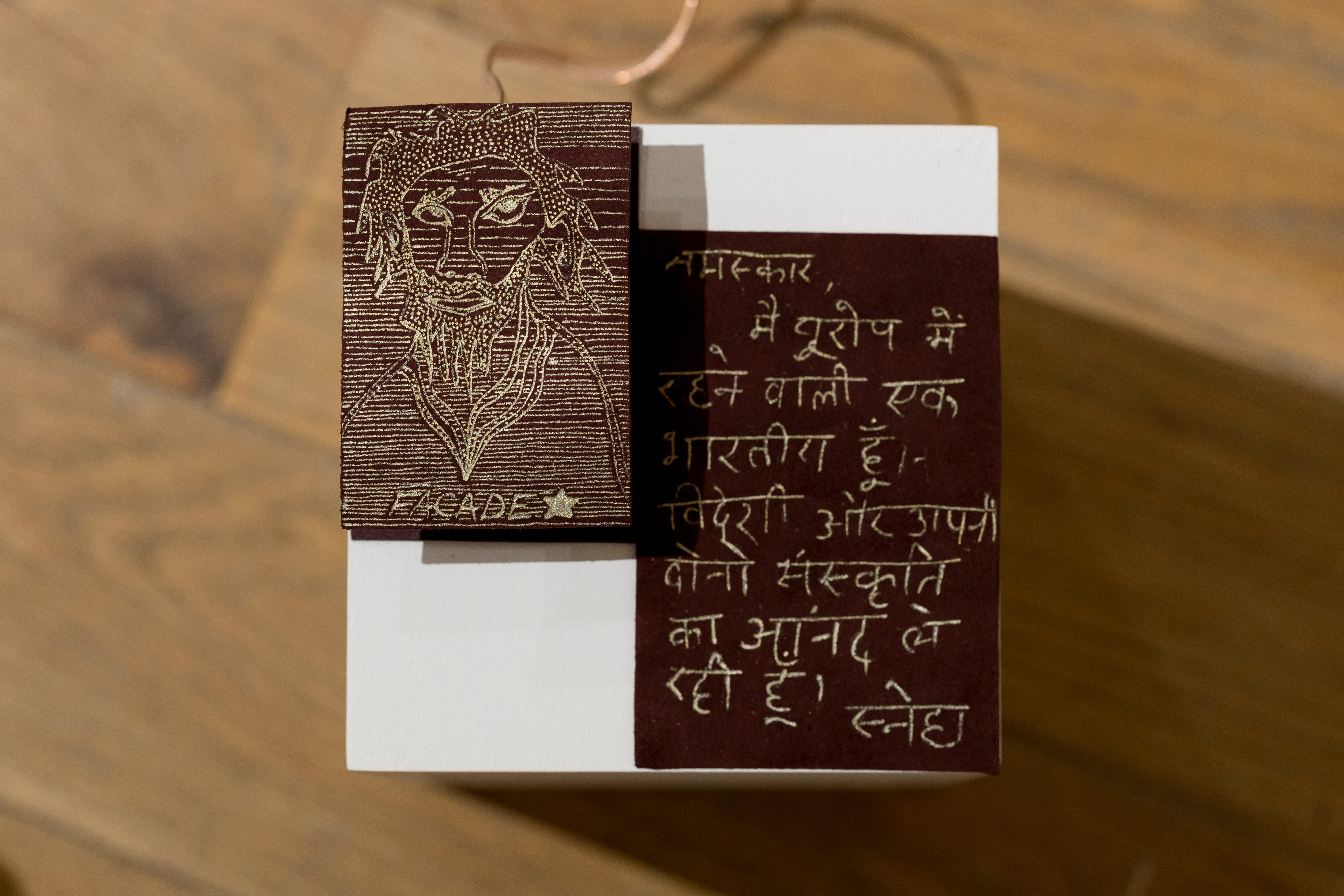
In South Shields he collaborated with Sangini, a Black and minorities women led community arts project. He describes the slow opening that listening makes possible. ‘Day one was quiet-ish,’ he recalls. ‘But then we found a connection through listening, through chatting, through eating. The second day was noisy. People found their voices and used them with great clarity.’ Songs, poems, stories - each emerging as if cued by the act of attentive listening. ‘These shared sounds appeared organically and were accepted with empathy, openness and support.’
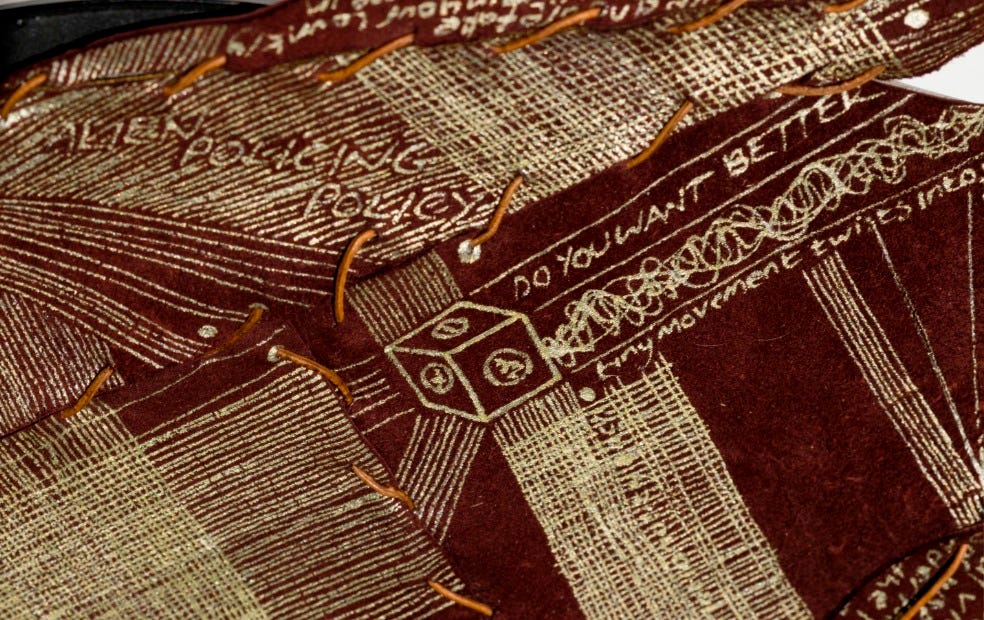
Art as Coalescence
Dima and Paul’s work offers routes toward coalescence. As Dima says, ‘Art created a space to meet… to respond to rupture by engaging with various acts of repair.’
Paul says: ‘These are moments in sound where temporal and spatial boundaries become fuzzy… giving the potential for political elasticity and to hear the spaces between where the marginal sounds so that we can start to bridge the gaps which divide us.’
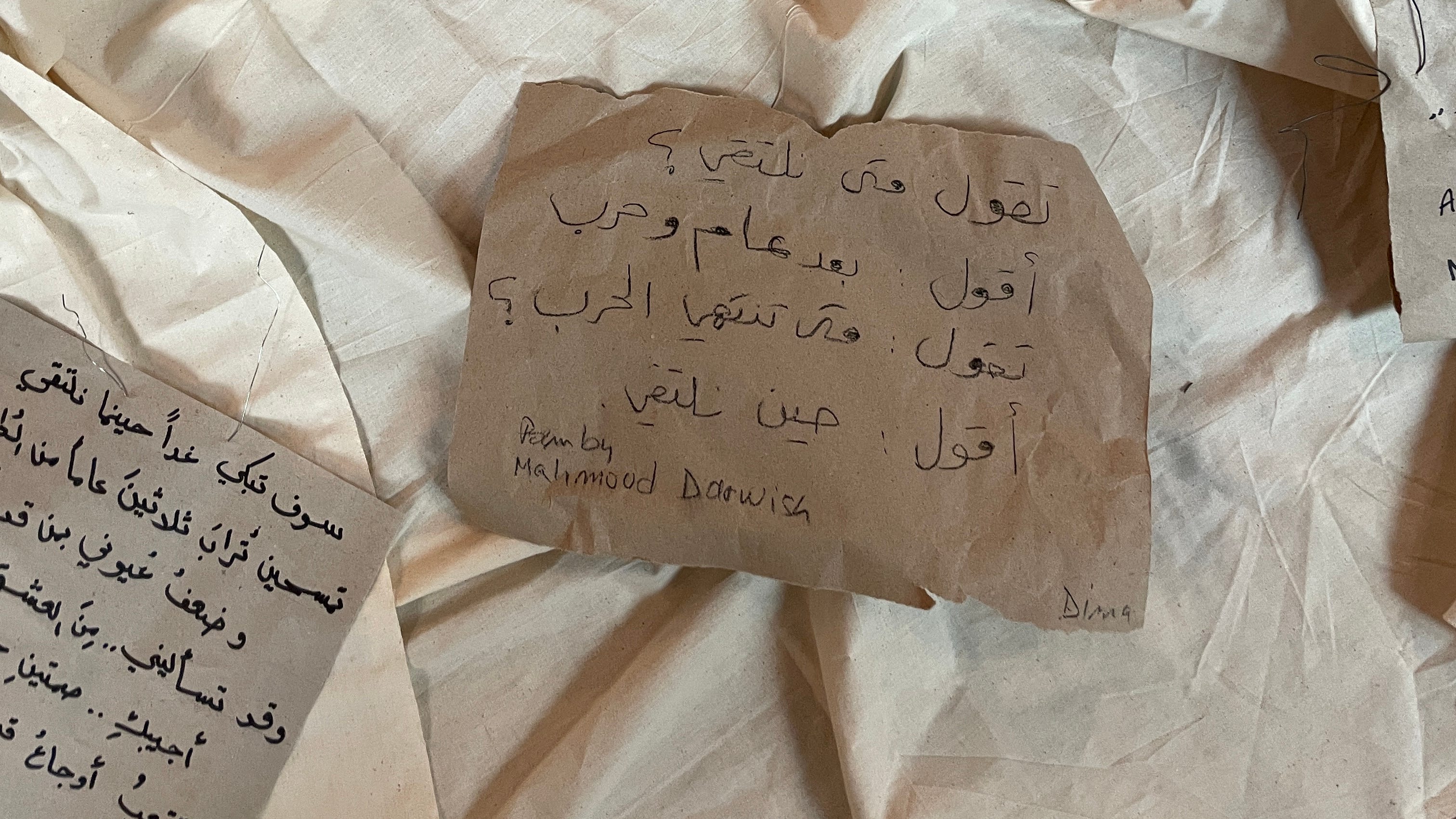
Dima closes her lecture with a poem by the Palestinian poet Mahmoud Darwish, one of the many written in Arabic on the 15-metre shroud exhibited at the Places We Carry exhibition. It translates to:
You say: when do we meet?
I say: after one year and one war
You say: when does the war end?
I say: when we meet.
She offers this line at the end of her presentation not as a conclusion, but as a continuation, an invitation to keep creating spaces where we meet, with all the meanings that this word carries.
Together, Dima and Paul suggest that coalescence is not accidental but emerges from artistic strategies, co-creation methodologies, creative investigations and acts of social engagement. A set of ethical and practical choices that leads us to decide on how we invite, what we sustain and how we hold space for complexity. It is not an outcome but an ongoing practice - one made of attention, care, and the courage to empower others to speak in their own time and write their own narratives.
D6 presented Art and Coalescence in Times of Rupture with Dima Karout and Paul Nataraj at Northumbria University on 26 November 2025. The lecture is part of Northumbria University’s Centre for Health and Social Equity (CHASE)’s public series that opens dialogue on inequality and community wellbeing.
D6: Culture in Transit is a visual arts producer working with extraordinary artists, communities and partners across continents with a shared belief in the value of the arts in creating a more just and equal society. From our studios Newcastle, we work in partnership to co-produce internationally significant and locally relevant art making connections between the North East of England and the rest of the world.
Find out more…